
More Sales, Less Cash: The growth paradox every CEO needs to understand
This is something that keeps coming up when I work with leadership teams, and I think it’s worth sharing.
At a glance
Senior leadership teams are often heavily focused on the P&L. Revenue is growing, margins look healthy and profit is ahead of last year, so the business appears to be performing well.
But there is another story being told on the balance sheet.
That’s where cash gets absorbed. It’s where the financial consequences of growth start to appear. And it’s often where the profit a leadership team believes it has created becomes trapped in receivables, inventory and work in progress.
The result can be a business that looks increasingly successful on its P&L while becoming increasingly cash constrained.
The real question isn’t simply whether the business is growing. It’s whether the growth is making the business financially stronger.
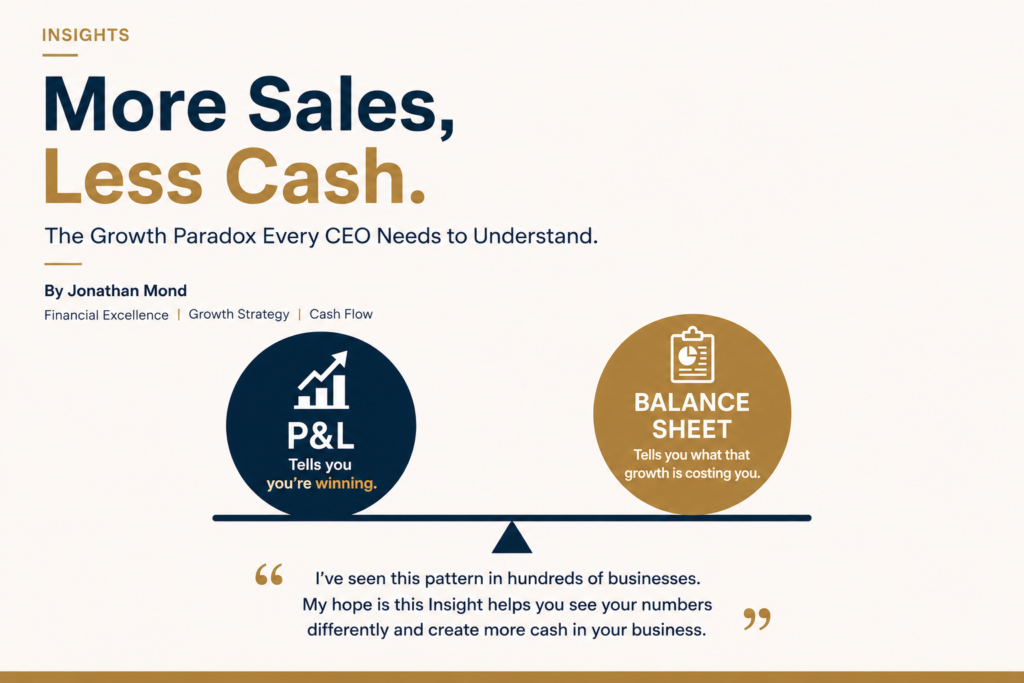
The P&L tells you what happened. The balance sheet tells you what it took.
The P&L is important. It tells us whether we’re generating revenue, whether we’re maintaining margin and whether we’re producing a profit.
But profit isn’t cash.
And a business doesn’t run on EBITDA. It runs on cash.
The balance sheet is where we see what is happening to that cash. It’s where receivables sit. It’s where inventory sits. It’s where work in progress sits. It’s where debt sits. And it’s where the cumulative financial consequences of thousands of decisions across the business eventually show up.
This is why I often say that the P&L can make you feel good while the balance sheet can tell you the truth.
You can have a great month on the P&L and still be putting enormous pressure on cash. You can be growing revenue and simultaneously increasing the amount of money trapped in the business. You can be reporting more profit while having less cash available to fund the next stage of growth.
That’s the paradox.
Nobody is spending enough time on the balance sheet
One of the things I challenge leadership teams on is how much time they actually spend looking at the balance sheet.
Most senior teams can tell me their revenue. They can tell me their gross margin. They can tell me whether EBITDA is ahead or behind budget.
But ask them:
“How many days of receivables are you carrying?”
Or:
“How many days of inventory have you got?”
Or:
“How much additional working capital will you need if you grow another 20%?”
And suddenly the conversation becomes much harder.
That’s not a criticism of leadership teams. It’s understandable. The P&L is where the action appears to be. Sales are happening. Profit is being reported. Targets are being measured.
The balance sheet can feel like something for the finance team to worry about.
But I think that’s a mistake.
The balance sheet is a leadership issue.
Because the balance sheet is where the cash gets absorbed.
Growth can hide your success
This is where growth becomes particularly interesting.
Imagine a business increases revenue by 20%.
The leadership team celebrates. And rightly so.
But if customers are taking longer to pay, receivables may have increased significantly. If the business needs more stock to support the additional sales, inventory may have increased. If projects are taking longer to complete, work in progress may have increased.
The business may have created more profit.
But some of that profit is now sitting inside the balance sheet.
It’s been converted into receivables. It’s been converted into inventory. It’s been converted into work in progress.
The profit is there.
But you can’t pay the wages with it. You can’t pay the supplier with it. You can’t put it in the bank.
Until it converts back into cash.
That’s why I say that growth can hide the profit you’ve created.
The faster you grow, the more important this becomes.
I’ve experienced this from both sides
This subject is particularly important to me because I’ve experienced it as both a CFO and a business owner.
When you’re responsible for making payroll, paying suppliers and funding the next stage of growth, you develop a very different relationship with the numbers.
Financial statements stop being something produced by the finance department at the end of each month. They become feedback.
They tell you what the decisions being made across the organisation are actually doing.
The sales team influences revenue and receivables. Purchasing decisions affect inventory. Operations influence productivity, margins and work in progress. People decisions affect capacity and overheads. Leadership decisions affect all of it.
Eventually, those decisions show up in the financials.
That’s why I’ve always believed:
Financials are the scoreboard of every decision.
The question I ask CEOs
Most businesses ask:
“How much did we grow?”
It’s an important question.
But I think there is another question that is often more important:
“What did that growth do to our cash?”
That’s where I start looking at the quality of growth.
Because not all growth is equal.
You can grow revenue and destroy margin. You can grow profit and consume cash. You can grow quickly and become increasingly dependent on external funding.
Or you can grow in a way that strengthens the business.
More profit. More cash. A stronger balance sheet. Greater strategic flexibility. And ultimately, a more valuable business.
That’s what I mean by quality growth.
Where I look first
When a leadership team tells me they’re growing but cash is becoming increasingly difficult to manage, I start looking at the balance sheet.
Are customers taking longer to pay?
Is accounts receivable increasing faster than revenue?
Is inventory growing faster than sales?
Is work in progress increasing?
Are we hiring ahead of the revenue we can confidently support?
Are margins being squeezed as we chase volume?
Are suppliers being paid faster than customers are paying us?
These aren’t simply finance questions.
They’re leadership questions. They’re strategy questions. They’re execution questions. And they’re ultimately cash questions.
The numbers allow us to see the consequence of those decisions.
Sometimes the biggest opportunity isn’t more sales
This is where my Power of One approach becomes particularly useful.
When I sit down with a leadership team, I don’t automatically start looking for another million dollars of revenue.
I want to understand what’s already happening inside the business.
What would a 1% improvement in price do?
What would a 1% reduction in COGS do?
What would another 1% of volume contribute?
What would a 1% reduction in overhead achieve?
What would collecting customers one day faster release?
What would carrying one less day of inventory release?
What would one additional day of supplier terms create?
These seven levers can look relatively small in isolation. But when you apply the actual numbers of the business, the combined impact can be significant.
Sometimes the answer isn’t: “We need more sales.”
Sometimes it’s: “We need to get more from the sales we’re already making.”
Bigger isn’t necessarily better
I’ve worked with businesses that were desperate to grow.
I’ve also worked with businesses where growth had happened so quickly that the growth itself had become a source of pressure.
The answer isn’t to stop growing.
Growth creates opportunity. It creates jobs, wealth and value.
The answer is to understand the financial consequences of that growth.
A stronger business isn’t simply one with more revenue.
It’s one with stronger margins, better cash generation, disciplined working capital, a healthy balance sheet and a clear path to increasing enterprise value.
In other words, the objective isn’t simply to get bigger.
It’s to get stronger.
So, what should CEOs be watching?
If your business is growing, I would encourage you to spend as much time understanding the balance sheet as you do celebrating the P&L.
Ask whether your margins are improving.
Ask whether profit is converting into cash.
Ask whether receivables are under control.
Ask whether inventory is growing faster than revenue.
Ask whether you’re effectively funding your customers.
And ask a question that doesn’t get asked often enough:
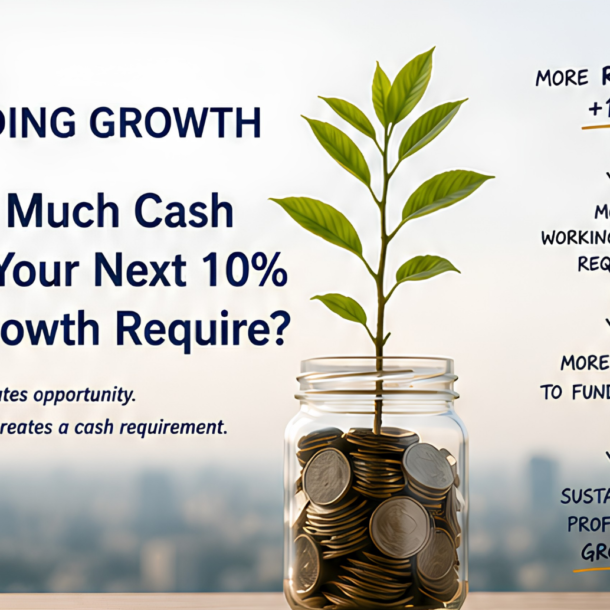
“How much cash will we need to fund our next 10% of growth?”
Perhaps the most important question of all is this:
Is our growth making the business stronger, or simply making it bigger?
That’s the distinction I believe every leadership team should understand.
Growth isn’t the goal.
Quality growth is.
And if you want to understand the quality of your growth, don’t just look at the P&L.
Look at the balance sheet.
That’s where you’ll see what the growth is really costing you.
Discover Your Financial Opportunity
If your business is growing and you want to understand what that growth is really doing to profit, cash and value, I’d welcome the opportunity to have a conversation.
Sometimes the biggest financial opportunity isn’t sitting in the next sales target.
It’s already inside the business.